
Ecological Support for Safe Tree Removal
Crick Road, Monmouthshire
Client:
Monmouthshire County Council
Location:
Crick Road, Monmouthshire
Services:
- Preliminary Ecological Appraisal (PEA)
- Ecological Clerk of Works (ECoW)
Overview:
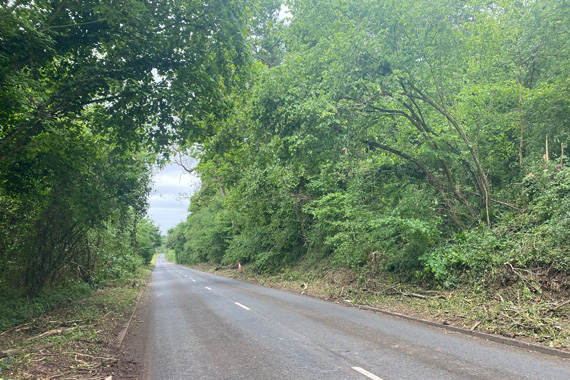
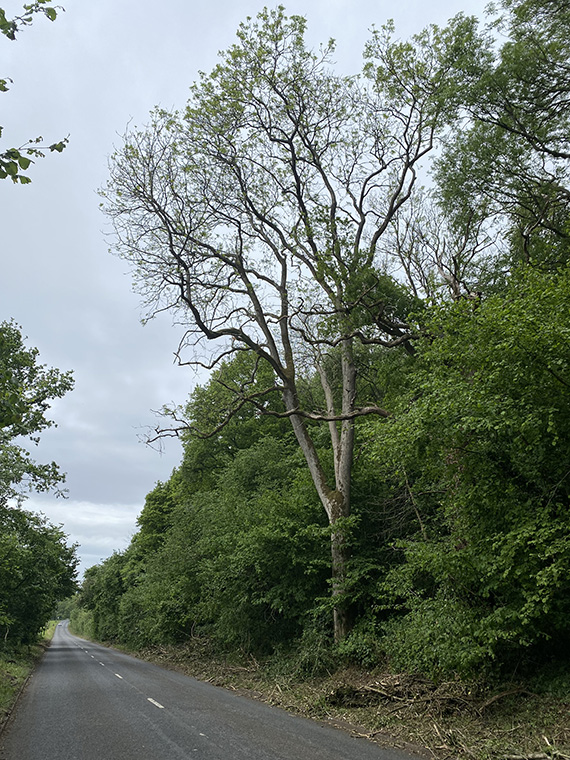
Wildwood Ecology provided ecological expertise to support the safe removal of dangerous trees affected by ash dieback along a 1km stretch of Crick Road. The trees, assessed by arborists as a health and safety risk to road users, required removal. Wildwood’s ecologists applied their extensive knowledge of dormouse ecology to ensure compliance with wildlife legislation and mitigate potential ecological impacts.

Challenge
During the winter of 2021/2022, deteriorating trees along Crick Road posed a serious health and safety risk, with branches frequently breaking and falling into the road, endangering users. However, the required tree removal intersected with habitat suitable for dormice, a legally protected species.
A desk study identified 19 dormouse records in the area, including one within 50m of the works. Additionally, three Sites of Special Scientific Interest (SSSIs) within 10km—Blackcliff-Wyndcliff, Coombe Valley Woods, and Penhow Woodlands—were designated for dormouse conservation. With strong habitat connectivity, there was a significant risk of disturbing or harming dormice, triggering legal and ecological constraints.
Wildwood Ecology needed to develop a strategy that ensured compliance with wildlife legislation while enabling the removal of hazardous trees to safeguard road users.

Approach
Given the urgency of the tree removal for public safety, a full dormouse survey was not feasible. Instead, Wildwood Ecology assumed dormouse presence based on existing records and habitat suitability confirmed by a dormouse-licensed ecologist during a preliminary walkover survey. This informed a successful dormouse licence application to Natural Resources Wales (NRW).
To ensure compliance with the licence and protect wildlife, Wildwood Ecology acted as Ecological Clerk of Works (ECoW) throughout the project. Key measures included:
- Contractor Training: Before works began, an ecologist delivered a toolbox talk to contractors, outlining ecological constraints, legal obligations, and best-practice working methods.
- Pre-Work Inspections: Ecologists conducted fingertip searches of vegetation, used endoscopes to inspect tree cavities and holes, and checked for nesting birds before any work commenced.
- Active Nest Protection: As the works overlapped with the bird nesting season, an active nest was discovered. A protective buffer was installed, and works in that area were halted until the chicks had fledged and the nest was confirmed inactive.
To compensate for habitat loss and enhance dormouse conservation, the project included:
- Installation of 50 dormouse boxes in retained vegetation.
- New habitat creation, including planting hazel, honeysuckle, blackthorn, bramble, hawthorn, and dog rose to enrich the understorey and provide a diverse food source.
- Oak tree planting along both sides of Crick Road to restore future canopy cover.
- Hedgerow establishment to connect woodland and existing hedgerows, improving habitat connectivity.
Outcome
The removal of diseased and dangerous trees along Crick Road was successfully completed, ensuring public safety while fully complying with wildlife legislation. Throughout the project, no dormice or other protected species were harmed, demonstrating the effectiveness of the ecological mitigation measures.
In addition to safeguarding wildlife during the works, the project contributed to habitat enhancement:
- New habitat creation increased foraging and shelter opportunities for dormice.
- Dormouse boxes installed on-site provide additional nesting and shelter options.
- Tree and hedgerow planting will support long-term ecological connectivity and biodiversity.
Experts in Ecology & Arboriculture
Ecology
- Ecological site assessments
- Biodiversity Net Gain
- Protected species surveys
- Protected species mitigation design and licence applications
- Habitat Regulations Assessment
- Ecological Clerk of Works
Arboriculture
- Tree surveys and arboricultural reports (British Standard BS5837:2012)
- Arboriculture Method Statements
- Arboriculture Clerk of Works
- Woodland and Parkland Management Plans
- Veteran and Ancient Tree Assessments